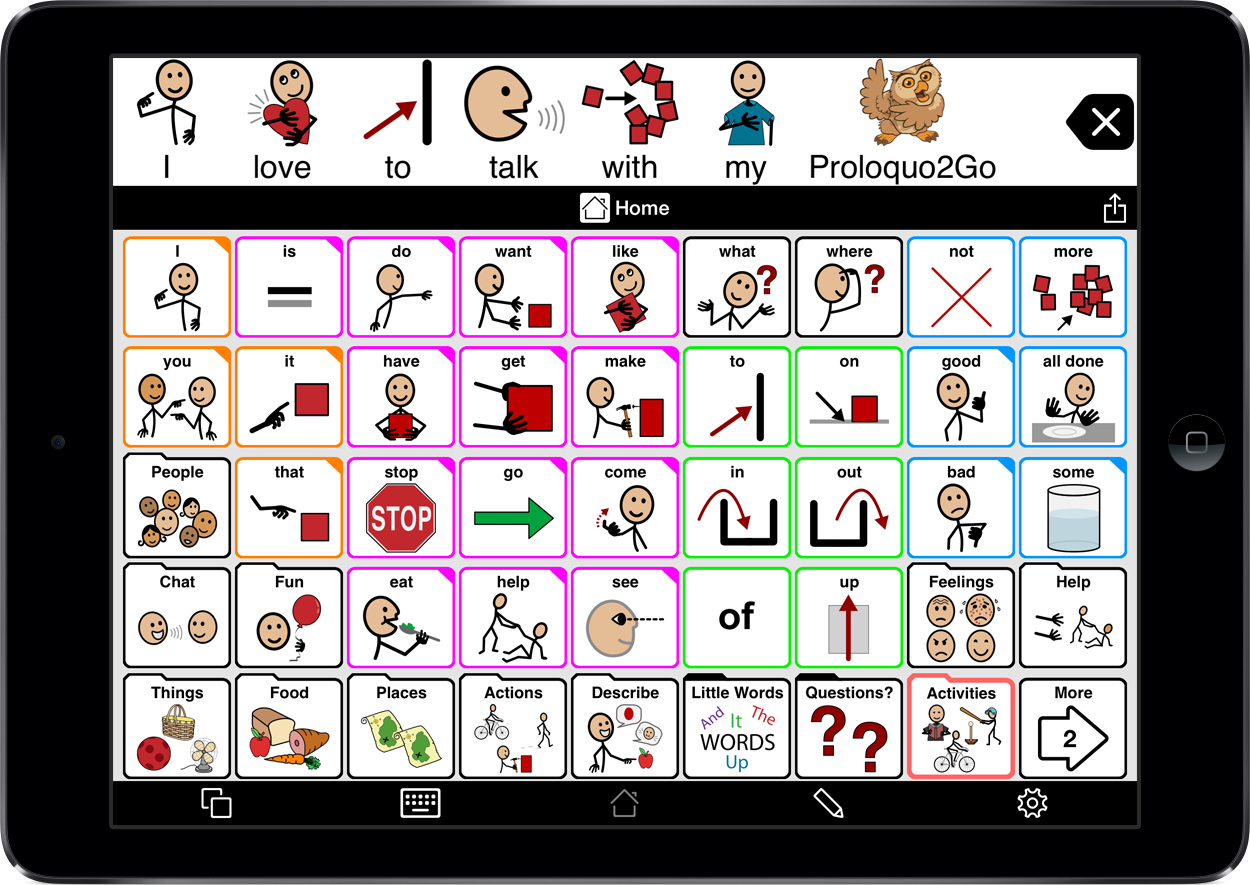
Augmentative and Alternative Communication (AAC) is a growing part of the field of speech-language therapy, and it is my absolute favorite part of the job. AAC is used by individuals who cannot use natural speech as their main means of communication, so they use other methods to add to or replace their speech. Recently, many AAC users use a communication app on a personal iPad or other tablet. They select words or phrases by touching the touchscreen, and the device says the words or phrases aloud for them. One of the most common AAC apps, Proloquo2Go, looks like this:
Learning to use a system like this is a lot like learning a
second language. It takes time and
effort on the part of the learner, and learning happens faster if the learner
is surrounded by other people who are competent communicators with their AAC system.
While immersing myself in AAC for the past few years, I’ve
come to recognize that there are two main approaches to learning how to use AAC
that parallel two methods for learning a second language. I call these two approaches the Phrase Book
Approach and the “Take a Class” Approach.
The Phrase Book
Approach
Imagine you’re planning a vacation to Japan. You’ll start in Tokyo and hit the most
popular tourist locations while you’re there.
You’d like to learn some Japanese to help you get by while you’re there,
but you don’t have much time to learn before your trip. So you pick up a phrase book.
You quickly learn a lot of really useful phrases that will
serve you well during your trip. But you
only learn the phrases that the author of the book predicted you might
need. Surely you’ll run into situations
where you’ll want to say something that the book’s author didn’t think to
include.
An AAC system that follows the Phrase Book approach might
look something like this:

Most of the buttons contain phrases or sentences – not single
words.
The Phrase Book Approach has many advantages for AAC
learners. It can be learned and implement very quickly. It doesn't take much time for the AAC learner to figure out how to make highly-motivating requests or statements with the touch of a single button. Phrases that create access to or participation in highly-preferred activities can be programmed in, which makes the AAC learner more motivated to use their AAC system. Phrases can also be programmed in that are meant to replace negative behaviors that sometimes occur when the student cannot communicate effectively with speech or gestures alone. The Phrase Book Approach is hands-down the best approach for reducing the frustration that many AAC learners experience when they cannot express themselves to others.
However, this approach does have some downsides. Since the message are all whole phrases or sentences, the AAC learner is limited to being able to say only what the person programming their system puts there. There is no easy way to create their own messages.
The “Take a Class”
Approach
Now imagine that you’ve just received a job offer for a
position in Japan, lasting at least a year.
You know that you’ll need to speak Japanese with most people at work and
in the community, since you won’t be in a place like Tokyo where a lot of
people speak some English. The job
doesn’t start for at least another year, too, so you have plenty of time to
prepare for the move. So you sign up to
take a Japanese class.
You begin learning basic vocabulary and grammar rules. You also spend plenty of time listening to
your instructor speaking fluent Japanese.
It’s slow going, especially at first.
It takes awhile before you feel like you’d be able to make yourself
understood to the average Japanese-speaker.
By the time the class is complete, however, you’ve built up
a respectable vocabulary and a good understanding of essential grammar
rules. You may not sound like a native
Japanese speaker, but you can express yourself in most situations. You can combine the words you know into a
huge variety of messages that, while they’re maybe not grammatically perfect,
clearly get your message across. You’re
likely to continue to improve your Japanese skills the more you practice and
interact with native speakers.
AAC systems that
follow the “Take a Class” Approach often look something like this:
The majority of the buttons contain a single word each.
The “Take a Class” Approach’s major drawback is the time and
effort it takes to learn. It takes a good long
time – sometimes multiple years – for the learner to learn enough vocabulary
and basic grammar rules to be a truly spontaneous communicator. It works most efficiently when the AAC
learner is surrounded by other people who also use their AAC system to
communicate with them, “demonstrating” how the learner can eventually use the
system themselves. This is a similar
concept to immersion programs for language-learning. So there is not only an investment of time
but also of effort. The AAC learner’s
friends, family, teachers, co-workers, etc., need to learn to use the system
themselves in order to be effective AAC “role models.”
The advantages of this approach, however, are numerous. While the process of learning a new language
word-by-word and rule-by-rule can be slow and often frustrating, it leads to a
worthwhile result – Spontaneous Novel Utterance Generation (SNUG). This is an acronym used in the AAC field to
mean the ability to say anything you
want to say by combining the words you know – without having to be taught the
word combinations. The “Take a Class”
approach is typically the only way for an AAC learner to achieve SNUG.
The Best Approach?
Like many things in life, there is no One Right Answer when
it comes to AAC. Generally, the best
approach tends to be a combination of both the Phrase Book Approach and the
“Take a Class” Approach. That way, the
AAC learner gets the advantage of being able to say a few highly-motivating
phrases immediately but also begins the longer process of developing truly
independent language use. But each AAC
learner is different, so the approach or combination of approaches should always
be tailored to the specific needs of the AAC user.
--Sarah